Mechanically Stabilized Earth (MSE) walls are modern retaining systems based on the composite interaction between soil and reinforcement. Developed as an alternative to conventional reinforced concrete retaining walls, these systems provide economical, rapid and reliable solutions, particularly for projects requiring high embankments along long alignments.
The fundamental principle of the system is the combined behavior of granular fill, which has negligible tensile strength, and reinforcement elements with high tensile capacity. Frictional interaction mobilized between the reinforcement and the granular fill provides the reinforced soil mass with apparent cohesion and resistance against outward lateral deformation under design loads, forming a composite reinforced soil system.
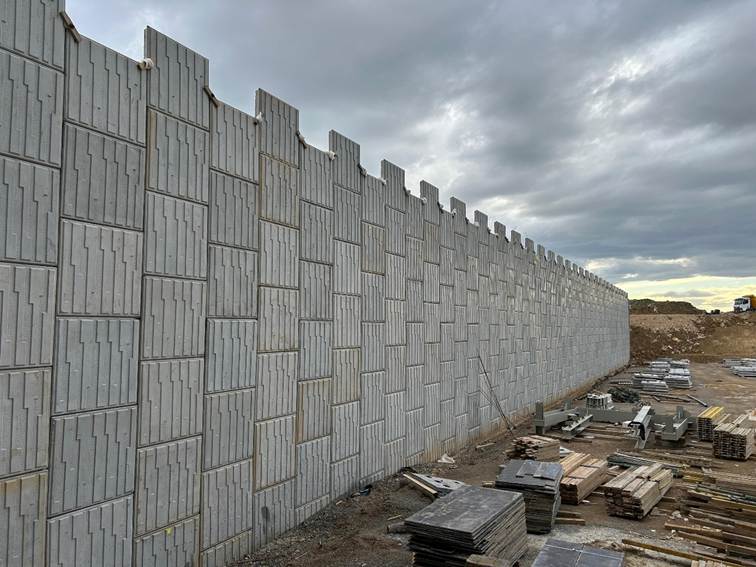
Working Principle
In MSE wall systems, steel or polymeric reinforcement elements placed at specified vertical intervals within compacted granular fill resist tensile stresses generated within the reinforced soil mass. Stresses induced under loading are transferred to the reinforcement through friction and interaction between the fill and reinforcement. As a result:
- The stability of the reinforced soil mass is improved
- Lateral deformations are limited
- Load-carrying capacity is increased
- Global stability is improved
The behavior of the system may be conceptually compared with reinforced concrete: concrete primarily resists compressive stresses while reinforcement carries tensile stresses. Similarly, in an MSE wall, the compacted fill primarily resists compression while steel or geosynthetic reinforcement mobilizes tensile resistance.
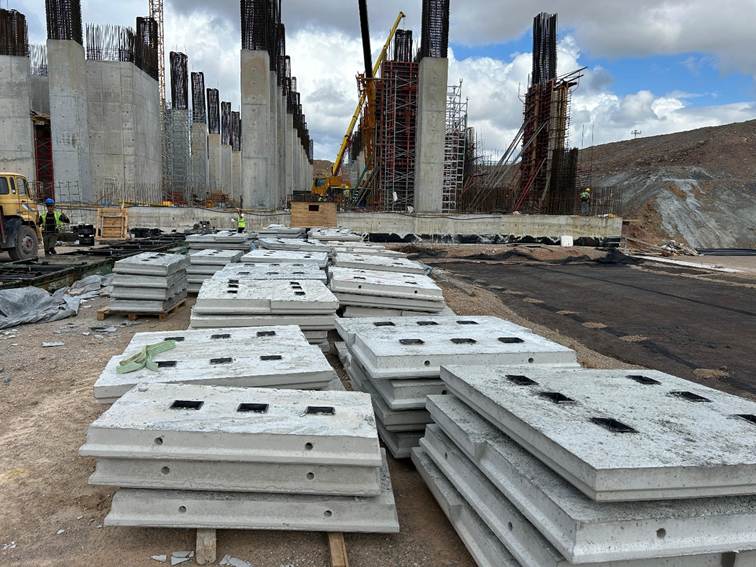
System Components
An MSE wall generally consists of the following main components:
- Granular backfill
- Reinforcement elements
- Galvanized steel strips
- Polymeric strips
- Geogrids
- Geotextiles
- Precast facing panels or steel facing elements
- Connection and anchorage elements
- Concrete leveling pad
The facing panels retain the reinforced soil mass while providing both a functional and architectural finish.
Why Use MSE Walls?
MSE wall systems are widely preferred for the following advantages:
Cost-Effective Solution for High Embankments
While the cost of conventional reinforced concrete retaining systems can increase significantly with wall height, reinforced soil solutions can remain comparatively economical for high embankments.
Seismic Performance
The system exhibits flexible rather than rigid behavior. This provides favorable deformation capacity under seismic loading and allows the structure to accommodate movements in a more controlled manner compared with brittle retaining systems.
Applicability over Weak Ground
Because the reinforced soil mass distributes loads over a relatively wide area, foundation contact stresses can be reduced. This can make MSE wall systems suitable for sites with relatively low bearing capacity, subject to appropriate geotechnical design and stability verification.
Rapid Construction
The use of precast facing panels together with layer-by-layer placement and compaction of the reinforced fill enables faster construction compared with many conventional reinforced concrete retaining wall systems.
Advantages in Confined Areas
Because facing systems can be constructed at inclinations approaching vertical, MSE walls provide an efficient use of space in urban projects where right-of-way or land acquisition constraints are critical.
Aesthetic and Architectural Flexibility
Facing panels can be manufactured with various patterns, textures and custom finishes, allowing the wall system to be integrated with architectural and landscape requirements.
Quality Control
Precast production enables facing panels to be manufactured under controlled conditions, supporting consistent quality and dimensional accuracy.
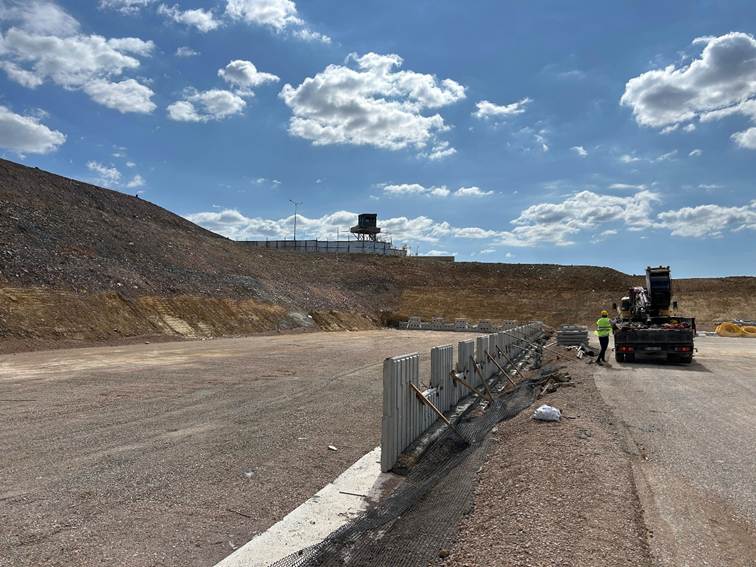
Applications
MSE wall systems are used in a wide range of infrastructure and engineering applications:
- Highway and motorway projects
- Bridge and interchange approaches
- Railway lines and overpasses
- Viaduct approach and side embankments
- Industrial facilities
- Organized industrial zones
- Port and quay structures
- River and stream rehabilitation projects
- Military and high-security facilities
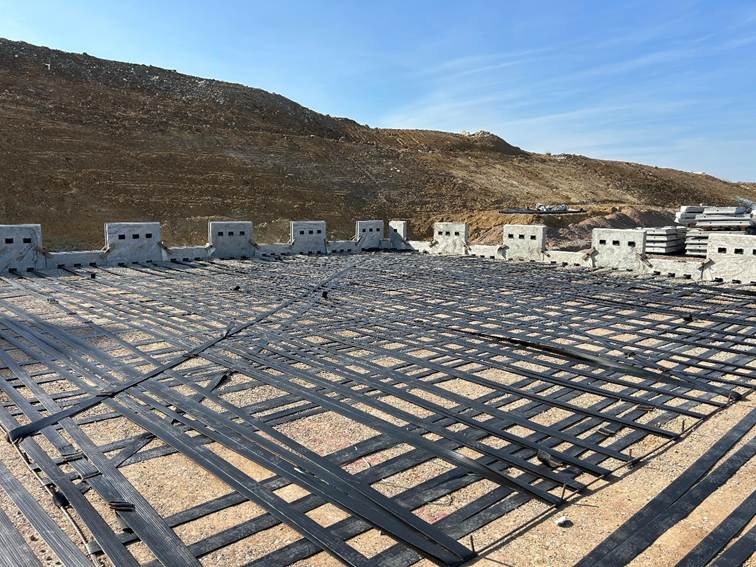
Construction Process
Construction of an MSE wall generally consists of the following stages:
- Preparation of the geotechnical and structural design
- Production and storage of precast facing panels
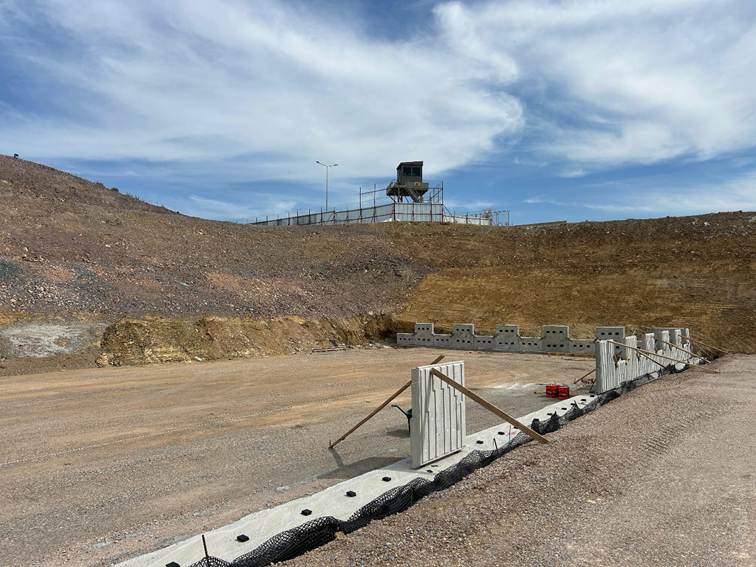
- Construction of the concrete leveling pad
- Installation of the first row of facing panels
- Placement and compaction of granular fill in successive layers
- Placement of reinforcement and connection to the facing elements at the specified elevations
- Repetition of the sequence until the final design elevation is reached
The fill is generally placed in controlled lift thicknesses, and each layer is compacted to achieve the required density and maintain the integrity and performance of the reinforced soil system.
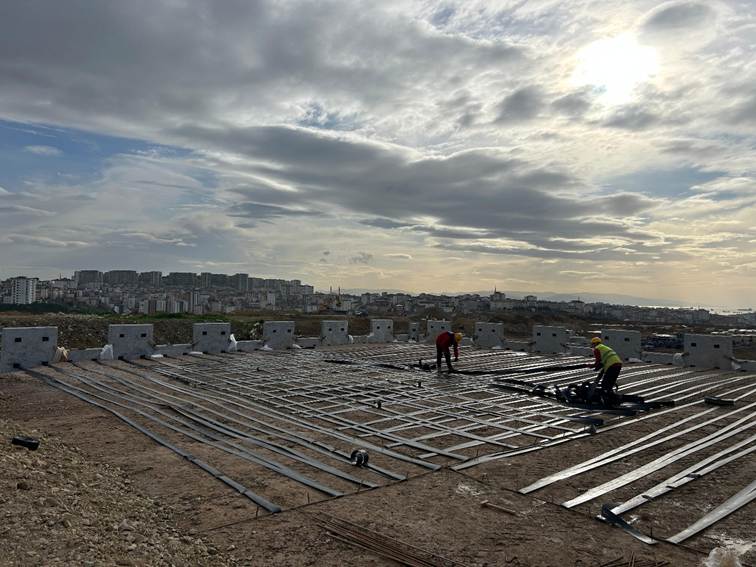
The Geotech Approach
At Geotech, our MSE wall engineering services include:
- Internal and external stability analyses
- Global stability assessments
- Performance assessment under seismic loading
- Optimization of reinforcement length and tensile strength
- Ground improvement recommendations for weak foundation soils
- Construction supervision and site control services
For each project, optimized engineering solutions are developed by considering fill properties, loading conditions, ground parameters, wall geometry and project-specific requirements as an integrated system.