Vibrations caused by many factors, including road and railway traffic, blasting, industrial activities, pile driving in construction, and earthquakes, can damage structures, people, vibration-sensitive equipment, and technical processes (Murillo et al., 2011). Since EPS consists of approximately 98% dry air, it has a structure that makes the transmission of vibration waves more difficult. For this reason, geofoam blocks can be used in seismic isolation and vibration damping applications.
In this field of application, geofoam blocks are placed in the ground as a barrier between the source of vibration and the areas where structures or people considered vulnerable to vibration or seismic loads are located. There are various applications in which geofoam blocks have been used as seismic isolation material.
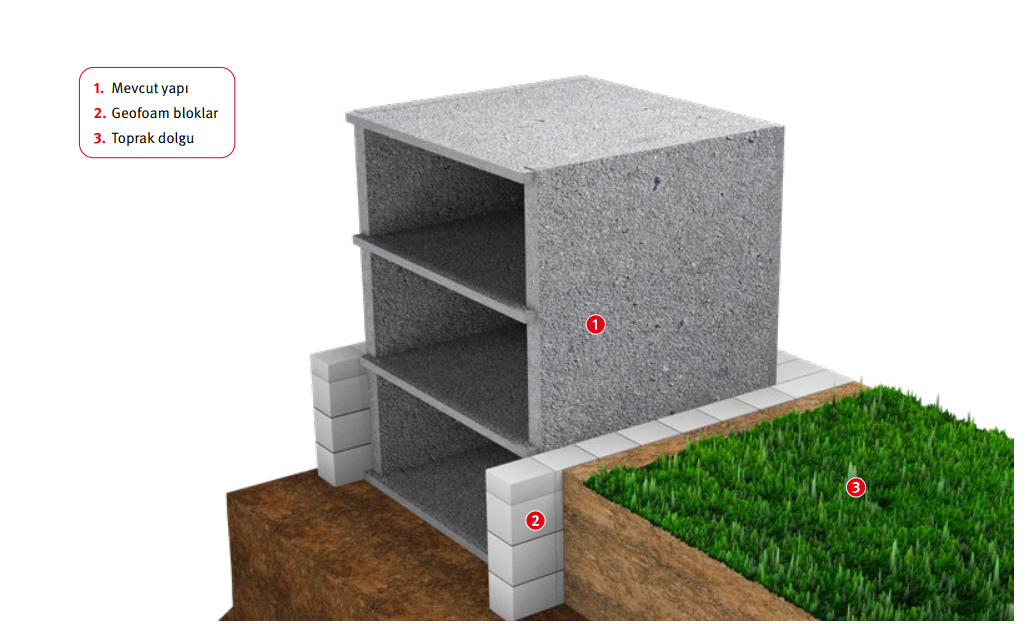
By placing geofoam blocks around the basement walls of a building, earthquake waves can be made to act on the structure with smaller amplitudes (Figure 1). Similarly, the Reduced Earth Pressure (REP) concept, which aims to reduce static lateral earth pressures acting on retaining walls, is also a seismic isolation application that helps reduce seismic loads.

Bathurst and Zarnani (2011) stated that, under conditions where the spring constant defined as the ratio of the initial tangent modulus of EPS (Eti) to geofoam block thickness (b), i.e. K = Eti/b, is less than 50 MN/m³, a geofoam seismic buffer can reduce the seismic loads transmitted from the ground to a rigid retaining wall by more than 50%. Athanasopoulos-Zekkos et al. (2012), on the other hand, reported that if geofoam blocks with a density of 20 kg/m³ and a thickness equal to 15–20% of the wall height are placed behind a non-rigid gravity retaining wall, reductions of up to 20% in the seismic loads transmitted from the ground to the wall and up to 50% in the horizontal displacements of the wall can be achieved. The geofoam block “lightweight fill” application intended to protect buried pipelines from ground movements caused by strike-slip faulting (Figure 3) can also be given as an example of a seismic isolation application that reduces seismic loads.

Another example of application is seismic isolation / vibration damping in machine foundations, which are major sources of vibration (Figure 4). The applications mentioned in the previous paragraph aim to attenuate vibrations transmitted through the ground so that they act on the relevant structure (basement wall, retaining wall, buried pipe, etc.) with smaller amplitudes (passive isolation). In applications involving machine foundations, the objective is to prevent damage to people, structures, vibration-sensitive equipment, and technical processes caused by the vibrations generated by the machine (active isolation). Majumder and Ghosh (2016) stated that when a circular trench excavated around a circular machine foundation is filled with geofoam blocks having a density of 11.2 kg/m³ (EPS 12, ASTM D6817), the vibration amplitude on the passive side of the barrier can be reduced by roughly 70–80%.

REFERENCES
- Murillo C, Thorel L, Caicedo B (2011) Isolation from ground vibrations with geofoam barriers: Centrifuge modelling. Proceedings of 4th International Conference on Geofoam Blocks in Construction Applications, Lillestrøm, Norway
- Bathurst R, Zarnani S (2011) Recent research on EPS geofoam seismic buffers. Proceedings of 4th International Conference on Geofoam Blocks in Construction Applications, Lillestrøm, Norway
- Athanasopoulos-Zekkos A, Lamote K, Athanasopoulos GA (2012) Use of EPS geofoam compressible inclusions for reducing the earthquake effects on yielding earth retaining structures. Soil Dynamics and Earthquake Engineering, 41: 59-71
- Majumder M, Ghosh P (2016) Active screening for axi-symmetric machine loading using EPS geofoam. Japanese Geotechnical Society Special Publication 2(66): 2238-2243