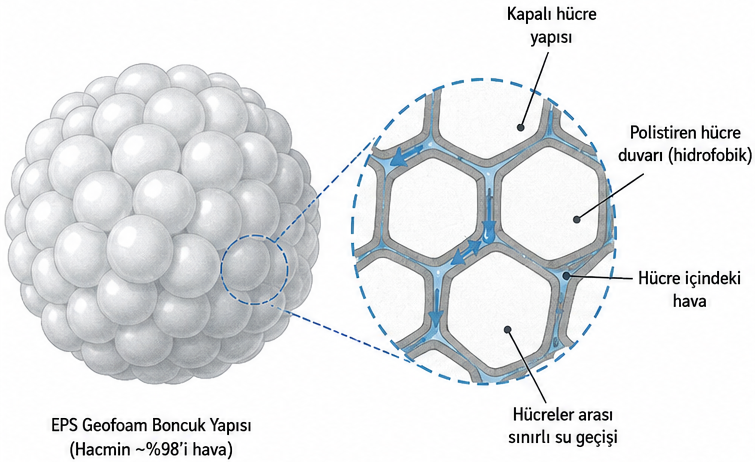
Expanded polystyrene (EPS) geofoam (geofoam blocks) has low water absorption due to its closed-cell structure. Considering that approximately 98% of the volume of expanded polystyrene (EPS) geofoam consists of air, geofoam blocks are an extremely lightweight geotechnical fill material. The closed-cell structure significantly limits the free penetration of water into the material (Horvath, 1994; Stark et al., 2004).
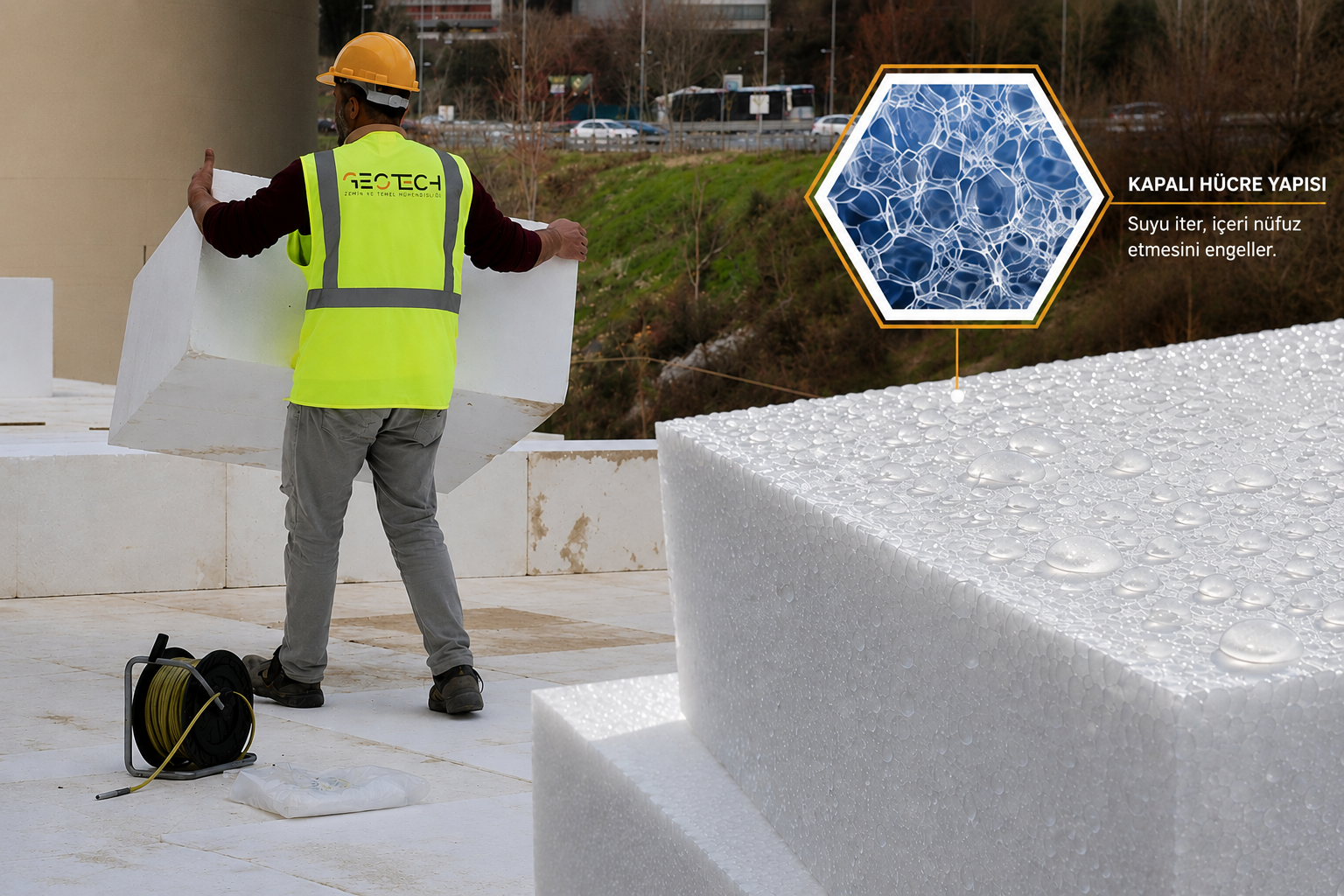
Because of its closed-cell structure, geofoam is described as hydrophobic. Hydrophobic behavior refers to the material’s tendency to repel water and its relatively low water absorption. However, this does not mean that geofoam is completely waterproof. A certain amount of water absorption may occur under prolonged exposure to water, continuous submergence, or where physical damage has occurred on the surfaces of the blocks (Borsatto et al., 2020).
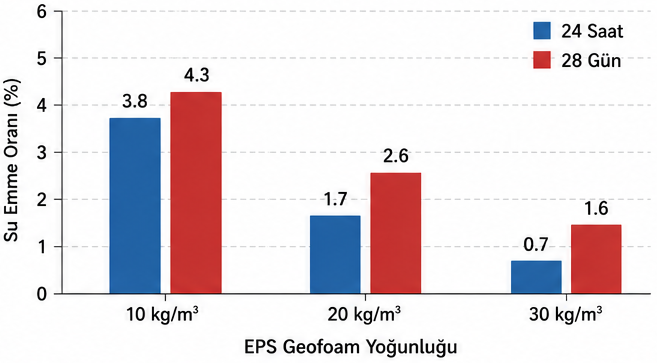
Laboratory studies have shown that the water absorption behavior of geofoam varies depending on its density and duration of exposure. In tests conducted in accordance with ASTM C272, Borsatto et al. (2020) reported 24-hour water absorption values of 3.8%, 1.7%, and 0.7% for specimens with densities of 10, 20, and 30 kg/m³, respectively. After 28 days of immersion, the corresponding values increased to 4.3%, 2.6%, and 1.6%.
These results clearly indicate that the water absorption capacity decreases as geofoam density increases. The primary reason is that higher-density geofoam blocks contain a lower volume of voids between the expanded polystyrene beads, thereby limiting the pathways through which water can penetrate.
Studies conducted by Ossa and Romo (2012) showed that water absorption behavior is influenced not only by density but also by the level of confining stress. Tests performed under different vertical stress levels demonstrated that the water absorption capacity of geofoam varies with the applied stress. However, water absorption was found to have no significant adverse effect on the compressive strength of geofoam.
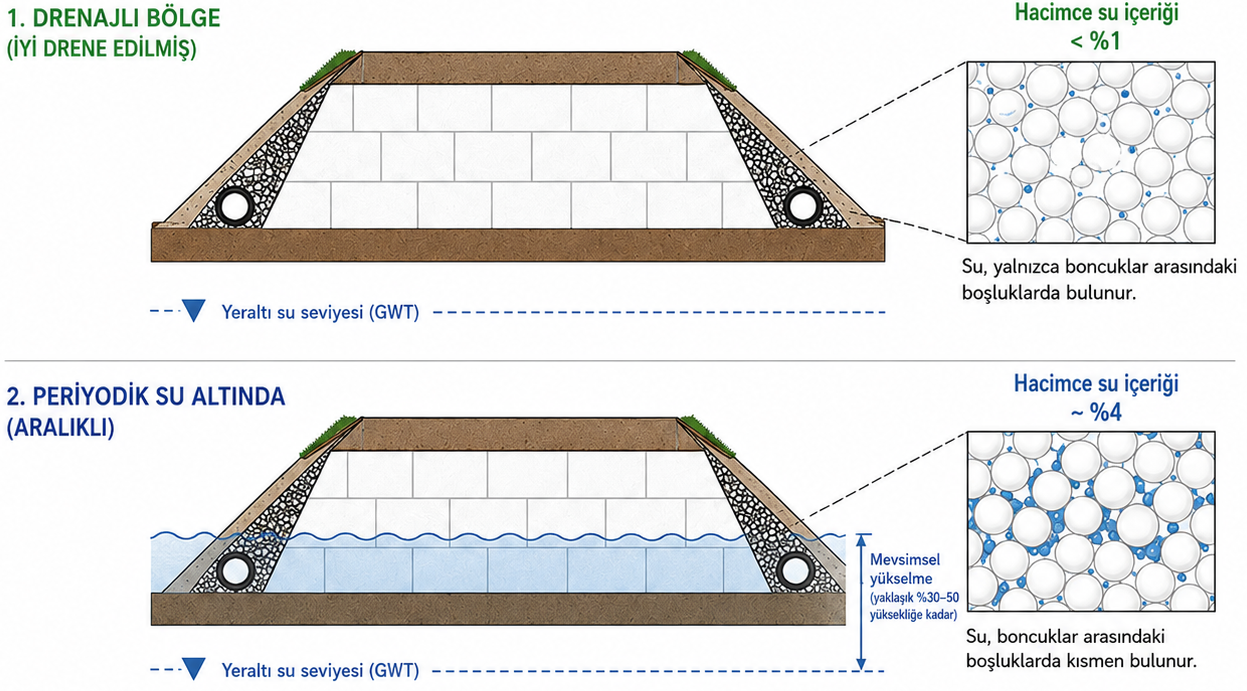
Long-term field observations in Norway also confirm the hydrophobic behavior of geofoam under actual field conditions. Aabøe and Frydenlund (2011) examined geofoam blocks that had been in service for more than 20 years and reported that their volumetric water content remained below 1% in well-drained areas. In contrast, water contents of up to approximately 4% were measured in blocks that had been periodically submerged.
These findings indicate that geofoam can retain its lightweight characteristics under well-drained conditions over long periods of service.
The hydrophobic nature of geofoam provides several important design advantages:
- Its low water absorption helps preserve its lightweight characteristics.
- It maintains its resistance to freeze-thaw effects.
- It provides long-term continuity of thermal insulation performance.
- It significantly limits capillary water transport.
- It contributes to stable long-term deformation behavior.
Nevertheless, drainage details should not be neglected in geofoam applications. The hydrophobic nature of the material does not eliminate the risk of hydrostatic uplift. The NCHRP (2004) report emphasizes that flood levels, drainage systems, and potential water accumulation should be considered in the design of geofoam fills.
Geofoam is a hydrophobic fill material that repels water and exhibits low water absorption; however, it should be designed together with appropriate drainage provisions.
These characteristics are among the key advantages that make geofoam suitable for lightweight fill applications, bridge approach embankments, earth-retaining structures, fills over weak ground, and lightweight fill construction over reinforced concrete slabs.
REFERENCES
- Horvath, J. S. (1994). Expanded Polystyrene (EPS) Geofoam: An Introduction to Material Behavior. Geotextiles and Geomembranes, 13(4), 263–280.
- Stark, T. D., Arellano, D., Horvath, J. S., & Leshchinsky, D. (2004). Geofoam Applications in the Design and Construction of Highway Embankments. NCHRP Web Document 65.
- Borsatto, M. B., Carneiro Neto, M. M., Rodrigues, R. A., Nogueira, C. G., & Lodi, P. C. (2020). Evaluation of the Water Absorption of Expanded Polystyrene After Different Periods. GeoAmericas 2020.
- Ossa, A., & Romo, M. P. (2012). Confining Stress Influence on EPS Water Absorption Capability. Geotextiles and Geomembranes, 35, 132–137.
- Aabøe, R., & Frydenlund, T. E. (2011). 40 Years of Experience with the Use of EPS Geofoam Blocks in Road Construction.